On February 15, 2027, I will turn fifty.
I find myself approaching this milestone with a desire to pause, take inventory, and make sense of the extraordinary amount of life I've lived over the past five or six years.
There have been job changes and professional reinventions, the end of a marriage, several moves, and the unlikely adventure of building a life in another country. I have experienced losses that left me questioning what I thought I knew about love and belonging, alongside triumphs that reminded me of my courage and capacity to begin again. I have worked to heal fractures within my family, reconsidered relationships I once assumed would last forever, and made difficult decisions about what I could continue to carry.
And now, standing at the threshold of fifty, I find myself returning to questions I have wrestled with for years.
What am I ready to release? What deserves to be carried forward? Which parts of myself have I neglected while attending to everyone else? What might become possible if I stopped measuring my worth through effort, accomplishment, and usefulness?
The questions are familiar, but my answers are evolving.
I do not expect to arrive at fifty with everything resolved. But I hope to arrive with a clearer understanding of what matters, a greater willingness to live according to those values, and the courage to let go of what no longer belongs.
* * *
Some losses are harder to make peace with than others.
For months, I have been grieving a sisterhood I once believed would last a lifetime. She was a sister of my choosing, one of the women who made San Miguel de Allende feel like home when I first arrived. There was laughter, companionship, affection, and the wonderful ease of believing I had found one of my people.
I miss those things. I miss her.
Our friendship did not unravel over a single disagreement. There were accumulated hurts, difficult conversations, and attempts at resolution that never quite brought us back to one another. I needed acknowledgment of things that had wounded me. She needed reassurance that the friendship itself was not in jeopardy.
We were both trying to reach each other. We aimed and missed.
Recently, I revisited our friendship through astrology, a practice I have long relied upon to deepen my understanding of myself and others. For me, astrology is part of healing. It offers another way to recognize the humanity in everyone involved, particularly when hurt makes that humanity difficult to see.
In astrology, the Moon represents our emotional world—our instincts, needs, and vulnerabilities. It is the water beneath the surface, the part of ourselves others may never fully see.
When I compared my birth chart with my friend's, I found an illuminating difference. Her Moon is in Sagittarius. Mine is in Capricorn.
A Sagittarius Moon suggests an emotional nature that seeks action, connection, and a way to move beyond the details toward the bigger picture. A Capricorn Moon seeks time to process, attention to detail, and personal accountability.
Looking back, I wonder if she was trying to tell me how much she loved me, while I was trying to tell her how much she'd hurt me. She wanted me to trust that our friendship was strong enough to survive. I needed to see that we could acknowledge what had happened and work together to make things right.
Perhaps we were each asking the other to recognize our love in a language neither fully understood.
Revisiting our friendship through astrology has allowed me to see both of us with greater tenderness. I can imagine more clearly now how differently we may have experienced the same conflict.
But tenderness is not amnesia; understanding her perspective does not erase what happened between us. The hurt remains, as does my longing to be understood with the same care I extend to others.
As a Black woman, I know how easily strength and eloquence can obscure vulnerability. Sometimes the more carefully I explain my hurt, the less people seem to recognize that I am hurting at all. My English-teacher attention to language may deepen that disconnect. When someone hurts me, I become an extraordinary advocate for my position. I recount events, establish timelines, identify inconsistencies, and construct arguments with the precision of a trial attorney. It is often much later, when the defending and explaining are finished, that I finally sit still long enough to cry.
And these days, when those tears come, Tim is there.
He doesn't need to know every detail or follow every argument to understand I'm hurting. He simply sees the woman beneath the words and responds with tenderness.
There is something profoundly healing about being loved by someone who doesn't require me to make a case for my pain.
* * *
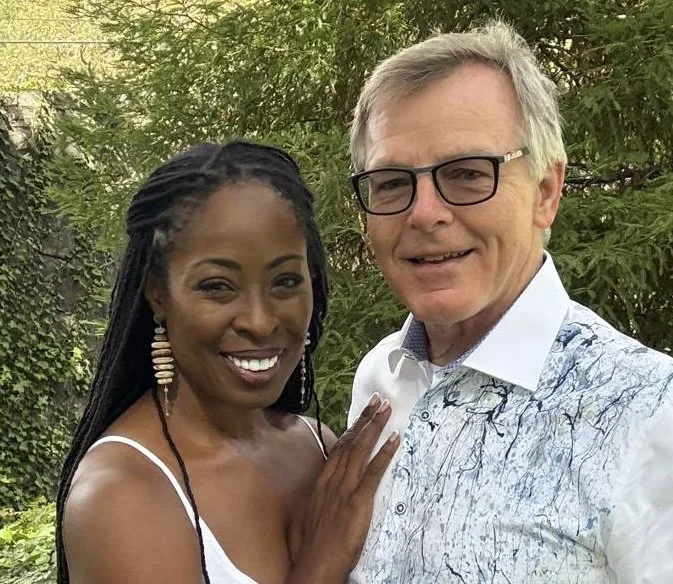
Tim is not a consolation for what I lost. For nearly two years, he has been my partner, my confidant, and the steady presence beneath so much of what I've built here, including the grief.
We met on December 11, 2024, aboard a Bajío Go shuttle traveling from Querétaro to San Miguel de Allende. It was an ordinary journey, and I had no idea how much that chance encounter would come to mean to me.
Some of life's loveliest surprises arrive without announcing themselves.
Tim considers me.
He thinks about how an experience might feel from my perspective. He notices when something has affected me. He doesn't require an elaborate explanation before recognizing that my feelings deserve care.
He is not a man of endless words, but his quiet attentiveness is one of the things I love most about him.
I wanted a partner who had moved beyond the urgency of building a career, someone eager to explore the world but equally content to slow down and enjoy it. In Tim, I found a man whose curiosity is matched by his contentment.
He can fix almost anything with his agile hands and analytical mind, and his tenderness toward my children has given me yet another reason to love him. It is in the smallest moments, though, that I see him most clearly: watching a bird, reaching for his camera to capture a fleeting bit of beauty, or lingering over something I might have hurried past. He has a way of reminding me that life is not always asking us to do something with it.
In September of this year, surrounded by the redwoods of Northern California, Tim and I exchanged our wedding vows on the lawn of the Benbow Inn.
There was no grand production. No elaborate performance of our happiness. Just the two of us, standing together and speaking honestly about the life we wanted to share.
It was intimate, uncomplicated, and ours.
In my vows, I told Tim that I wanted the adventures we hadn't imagined yet, and the quiet evenings when absolutely nothing happens.
I meant both equally.
For much of my life, I have measured my days through responsibility, accomplishment, service, and the needs of others. I have been a teacher, a leader, a mother, an advocate, a woman expected to know what to do and how to do it.
These roles have brought purpose and meaning to my life. But they have not always left much room for the softer, less certain parts of me.
With Tim, I am discovering that I do not have to be exceptional to be cherished.
I can be quiet. I can be tired. I can change my mind. I can spend an afternoon reading, take a nap without apology, or simply enjoy the pleasure of having nowhere I need to be.
I can be a woman who gives deeply and also receives.
* * *
As I prepare to turn fifty, I find myself holding grief and gratitude in the same hands.
I can grieve the loss of a sisterhood and remain grateful for all that it gave me. I can honor the love that has left my life while celebrating the love that has arrived.